


Cozumel is one of the most famous destinations in the Mexican Caribbean and at the same time an island that has much more to offer than a classic cruise stop. Turquoise waters, offshore coral reefs, thousands of years of Mayan history and a relaxed, authentic atmosphere make Cozumel a special place. We visited the island as part of a cruise on the Icon of the Seas and deliberately opted for a private, German-speaking tour of the island with Leon Tours Mexico. This combination enabled us to get to know Cozumel intensively, stress-free and far away from mass tourism.
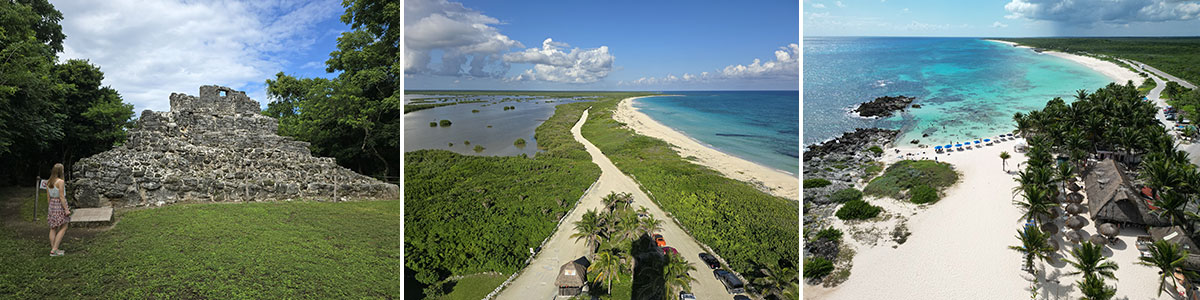
Table of contents
Where is the island of Cozumel?
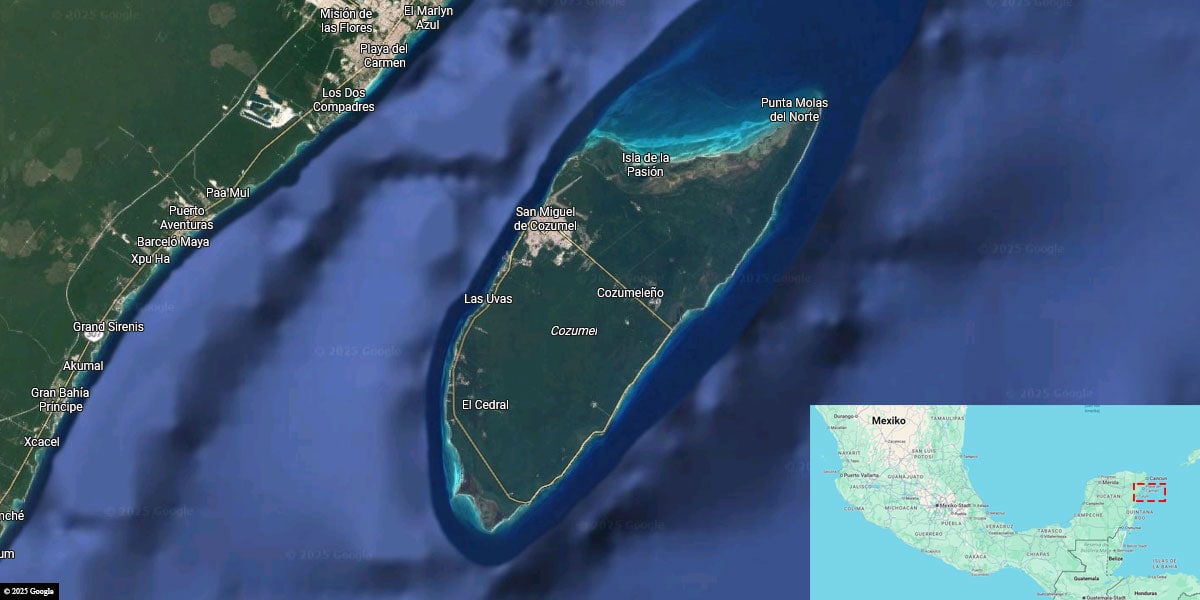
The island of Cozumel is located in the Caribbean Sea off the east coast of Mexico’s Yucatán Peninsula (location in Google Maps). It is politically part of the state of Quintana Roo, which is known for some of Mexico’s most popular vacation spots, including Cancún, Playa del Carmen and Tulum. Cozumel is located about eighteen kilometers off the mainland and is separated from continental Mexico by a strait.
With a length of around forty-eight kilometers and a maximum width of around sixteen kilometers, Cozumel is the third largest island in Mexico. The heart of the island is San Miguel de Cozumel, the only larger town and also the economic and tourist center. The west coast is much more developed, as it is protected from strong waves by the mainland. The east coast, on the other hand, is rougher, more pristine and has a particularly impressive landscape. Cozumel is located directly on the Mesoamerican Barrier Reef, the second largest coral reef system in the world. This geographical peculiarity has made the island one of the best diving and snorkeling areas in the Caribbean.
Where is the island of Cozumel?
Interesting facts about the island of Cozumel
The name Cozumel comes from the Mayan language and is often translated as “island of the swallows“. Long before the arrival of the Spanish, the island played a central role in the religious life of the Maya. Cozumel was considered a sacred place, especially for the worship of the goddess Ixchel, who was associated with fertility, birth, healing and the moon. Women from all over the Maya region made pilgrimages to Cozumel to offer sacrifices in the temples and ask for the blessing of the goddess. With the Spanish conquest in the 16th century, life on the island changed drastically. Diseases and forced labor led to the almost complete disappearance of the population. Cozumel was virtually uninhabited for many decades before permanent settlements began to form again in the 19th century. Today, the island is a fascinating mix of pre-Columbian history, colonial influences and modern tourism infrastructure.
The climate on Cozumel is tropical and warm all year round. Temperatures are usually between twenty-five and thirty degrees Celsius. The best time to visit is from December to April, when it is drier and the humidity is considered more pleasant. The hurricane season officially lasts from June to November, although Cozumel is often less affected than other regions of the Caribbean thanks to its location. The national language is Spanish, but due to international tourism, English is also spoken in many places. The Mexican peso is the currency of payment on the island, although US dollars are often accepted in tourist areas.
One of the cultural highlights is the Mayan site of San Gervasio, which has special historical significance as the spiritual center of the goddess Ixchel. Cozumel is also known worldwide for its spectacular coral reefs such as the Palancar Reef, which, as part of the Mesoamerican Barrier Reef, is one of the best diving and snorkeling areas in the Caribbean. The Chankanaab Adventure Beach Park, which combines beach, lagoon, nature and leisure activities, is also very popular with visitors. Here, visitors have the opportunity to swim with dolphins, snorkel in protected lagoons or learn to dive as part of organized programmes.
A stark contrast to this is the Punta Sur Eco Beach Park in the south of the island, an extensive nature reserve with lagoons, mangroves, dream beaches and the historic Faro de Punta Celarayn lighthouse, which offers an impressive view over Cozumel. Playa Punta Sur is considered one of the most beautiful beaches on the island and is synonymous with tranquillity, nature and Caribbean flair. In San Miguel de Cozumel, visitors experience the urban heart of the island with its waterfront promenade, restaurants, markets and authentic everyday life, while the Museo de la Isla de Cozumel provides a compact insight into the history, culture and nature of the island. The offer is complemented by places such as Bahía Chen Rio on the wild east coast, the traditional village of El Cedral and experiences such as Stingray Beach, where visitors can get particularly close to Cozumel’s fascinating marine world.
International Cruise Terminal Cozumel
Cozumel is one of the most important cruise ports in the Caribbean. There are several modern cruise terminals along the west coast of the island, which are called at daily by numerous international shipping companies. Our ship, the Icon of the Seas, also moored here. There are numerous stores, souvenir stores, bars and restaurants directly at the terminals that cater specifically to cruise guests, such as the Margaritaville Cozumel.


German-speaking island tour in Conzumel with Leon Tours Mexico
In the run-up to our trip, we specifically looked for German-speaking private excursions on Cozumel and found Leon Tours Mexico.
Leon Tours is a small, family-run German-Mexican travel agency based in Cozumel, founded in 2016 by Birgit and Gerson. They organize private tours according to individual wishes and also offer excursions in small groups on Cozumel and to highlights of the Riviera Maya. The focus is on the Yucatán Peninsula, its underwater world and the cultural Mayan sites. Birgit is from Munich and came to Cozumel as a diving instructor; Gerson is from Mexico and knows a lot about Mexican history and Mayan culture and leads the tours in German, English and Spanish.
We met up with Birgit just outside the harbor at 9 a.m. and started our tour.
Leon Tours Mexico
San Miguel de Cozumel
San Miguel de Cozumel is the largest town on the Caribbean island of Cozumel and the administrative center of the municipality of the same name in the Mexican state of Quintana Roo. The city has around 85,000 inhabitants and is located on the protected west coast of the island, where the port and ferry connections to the mainland also start. In the 19th century, the current settlement grew due to immigration during the Caste War on Yucatán, and San Miguel was officially recognized in 1849. Today, cruise tourism, diving and snorkeling activities dominate the cityscape – not least because of the famous coral reefs, which are part of the Mesoamerican reef system and make Cozumel one of Mexico’s best-known diving destinations.
San Miguel de Cozumel has relatively few “classic” sights to offer, which is why we only made a short detour to Cozumel International Airport, where a few military airplanes are on display. From there, our journey continued to the center of the island.


The Mayan site of San Gervasio
The first major item on our island tour was the archaeological site of San Gervasio, the most important Mayan ruin on Cozumel, located in the middle of the green jungle. San Gervasio was once an important religious center, primarily for the worship of the goddess Ixchel. Women from all over the Mayan empire traveled here to ask for fertility, protection and healing. During our tour of the complex, Birgit told us a lot about the history of the Maya on Cozumel, the significance of the individual buildings and the religious rituals. Although San Gervasio does not appear as monumental as the large ruined cities on the mainland, the place conveys a very authentic picture of the spiritual life of the time.
Estructura Manitas
The Estructura Manitas is one of the most striking areas of San Gervasio and is often described as part of a ceremonial complex where ritual acts and processions may have taken place. Characteristic are the low, rectangular building forms on a platform, which show typical elements of East Mayan architecture on Cozumel: functional spaces, clear axes and a structure aimed at communal use rather than monumentality.


Estructura Chichan Nah
Chichan Nah means “small house” and thus fits a structure that suggests rather intimate, roofed rooms – possibly for priests, administration or the preparation of rituals. Compared to prestigious temple buildings, this area appears more compact and closer to everyday life: low room heights, simple transitions and a floor plan that allows for practical use.


Estructura El Arco
Estructura El Arco is best known for its arched passageway or “gate” motif and is often perceived as a spatial threshold within the complex. Such transitions are not merely decorative in Mayan sites, but structure movements: Those who pass through them consciously enter a different section – for example, from the publicly accessible area into a more ceremonial courtyard.


Estructura El Álamo
The Estructura El Álamo is located in an area where the interplay of architecture and surrounding vegetation is particularly noticeable – an aspect that is typical of Cozumel with its flat terrain and dense vegetation. The building itself is less spectacular than central temple platforms, but that is precisely what makes it interesting: it shows how the Maya created spaces that provided shade, protection and clear usage zones.


Estructura Kana Nah
The Estructura Kana Nah is often interpreted as a “large house” and is one of the more important structures within San Gervasio. The structure appears more representative, with a clearly recognizable platform and an arrangement that suggests assemblies, ritual preparations or administrative activities. Several functions are often concentrated in such “house” complexes: They are simultaneously a stage, a workspace and a symbol of order and authority.


Bahía Chen Rio – The wild east coast of Cozumel
After visiting San Gervasio, the tour continued to the east coast of the island. The contrast to the sheltered west side could hardly be greater. At Bahía Chen Rio, Cozumel shows its original, rugged side. Strong waves meet the coast here, bizarre rock formations characterize the landscape and the open Caribbean Sea stretches to the horizon. Bahía Chen Rio is known for its natural pools protected by rocks, where you can even swim in calm conditions. We mainly used the short stop to enjoy the impressive natural surroundings, take photos with our drone and breathe in the fresh sea air.


Punta Sur Eco Beach Park – natural paradise in the south of the island
Another highlight of our island tour was the Punta Sur Eco Beach Park in the south of Cozumel. This extensive nature reserve combines beautiful beaches, lagoons, mangroves and cultural sights.


Playa Punta Sur
We drove along a gravel road to Playa Punta Sur, one of the most beautiful beaches on the island. Fine, light-colored sand and crystal-clear water create an almost unreal backdrop. Despite the popularity of the park, the beach never feels overcrowded, making it the perfect place to relax. We had plenty of time to enjoy the atmosphere and snorkel a little in the shallow water.
With a bit of luck, you can also often see raccoons or trusting cute coatis here ❤


Faro de Punta Celarain
A special highlight in the Punta Sur Eco Beach Park is the Faro de Punta Celarain (Faro Celarain), the lighthouse at the southern tip of Cozumel: the current lighthouse was built in 1934 (as a replacement for an earlier facility) and is around 33 meters high. A narrow spiral staircase with 133 steps takes you to the viewing platform – at the top you can enjoy an impressive 360-degree view over the lagoon and mangrove landscape of Punta Sur, the turquoise coastal waters and, on a clear day, far across the island.


Colombia Lagoon (Laguna Colombia)
The Colombia Lagoon (Laguna Colombia) is the large lagoon and mangrove system in the Punta Sur Eco Beach Park in the south of Cozumel and is considered one of the best places on the island to experience the natural side away from the beaches. The shallow, partly salty waters are surrounded by mangroves and are an important habitat for many bird species as well as crocodiles, which can be observed from the viewpoint if you are lucky. The contrast is particularly exciting: on one side the calm, green-brown lagoon, on the other side – just a few meters away – the open Caribbean with surf and turquoise water.
Around 4 p.m. we slowly drove back from the southern tip towards the harbor in San Miguel de Cozumel.



Our conclusion about the island of Cozumel
More activities & tours on Cozumel
Of course, there are many more activities and tours that you can do on Cozumel. Enclosed you will find a small selection. You can also find many of them on GetYourGuide.
Diving in the marine park (Palancar & Co.) – Cozumel is world-famous for drift dives, clear visibility and impressive reef walls.
Snorkeling tour to Palancar/Columbia & “El Cielo ” – reefs plus the iconic sandbank for drifting and observing marine life.
Chankanaab Beach Adventure Park – Beach day with easy reef edge snorkeling, nature areas and activities in the park.
Isla de la Pasión – short trip to relax, swim, kayak and hammock (often by boat/catamaran).
Beach Club Day Pass – “all inclusive” beach day with service, sunbeds, food/drinks and often pools.
Atlantis Submarine – dive with the submarine and see the underwater world without snorkeling or diving.
Jeep/buggy/ATV island tour – off-road feeling, combine several stops and “circumnavigate” the island in a short time.
Museo de la Isla de Cozumel – compact museum visit on island history, nature and culture (good in hot/rainy weather).
Sea Walls Murals / Street Art Walk – large murals in the center of San Miguel, perfect for an evening stroll.
Golf on Cozumel – 18 holes in a tropical setting, often with exciting nature surrounding the course.
Kitesurfing/wind sports – particularly exciting on the east side depending on the wind; alternatively SUP, kayaking or jet skiing.