


We visited Costa Maya during our cruise on Royal Caribeean’s Icon of the Seas. Between dense jungle, millennia-old Mayan culture and turquoise-blue lagoons, a varied day trip awaited us, taking us from the impressive Mayan ruins in Chacchoben to the world-famous 7-colored lagoon of Bacalar. In this article, we take you on a tour of our impressions of Costa Maya, share practical information for cruise guests and show you why a shore leave here is definitely worthwhile.
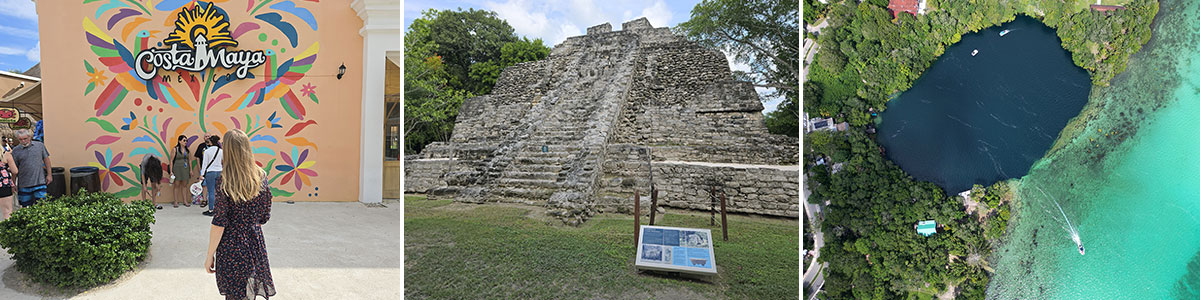
Table of contents
Where is Costa Maya actually located?
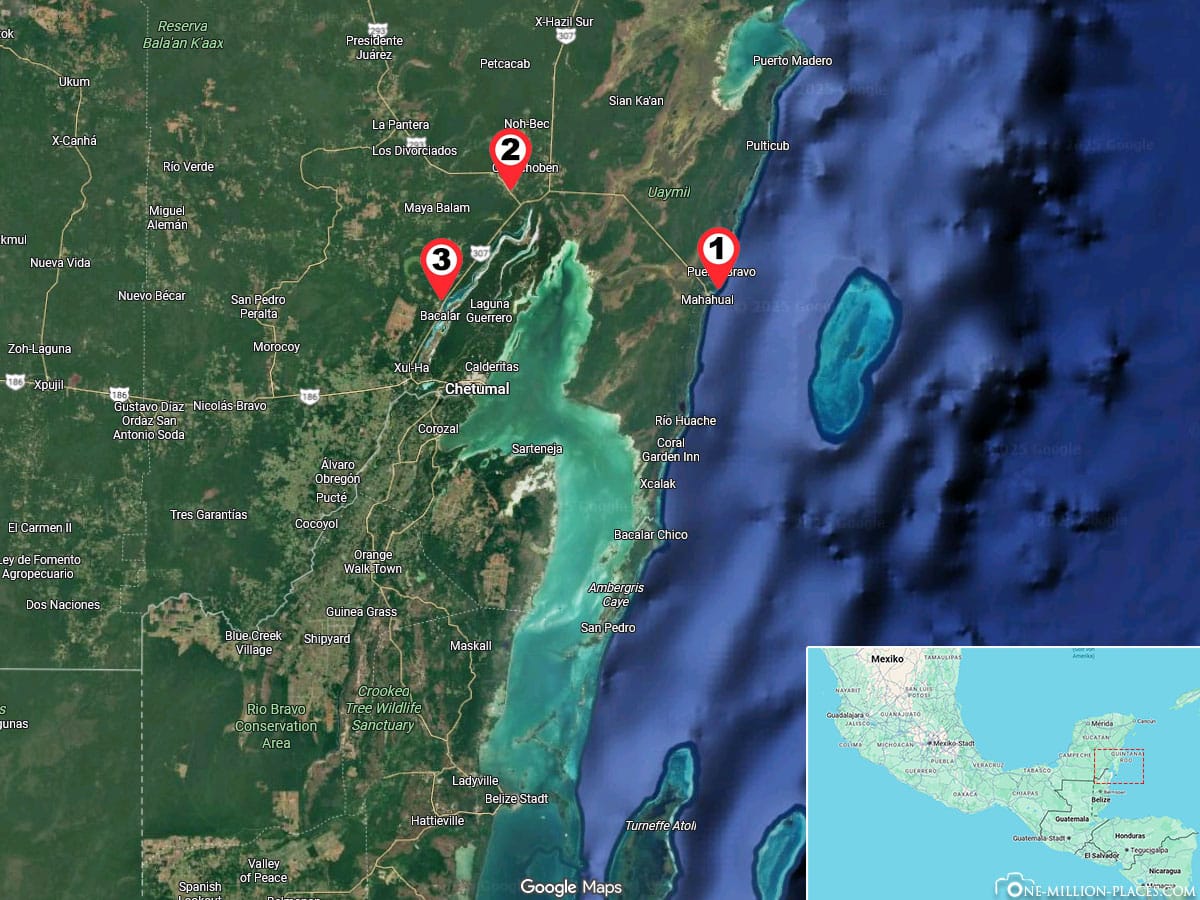
Costa Maya is located on the southern Caribbean coast of Mexico in the state of Quintana Roo on the Yucatán Peninsula. (Link in Google Maps) The town is located just a few kilometers north of the border with Belize and is geographically one of the most culturally and naturally rich regions in Central America. Unlike well-known tourist strongholds such as Cozumel, Cancún or Playa del Carmen, Costa Maya is not a classic vacation resort, but a specially developed cruise port.
The port of Costa Maya is located near the small fishing village of Mahahual and was built in the early 2000s specifically for large cruise ships. Today, it serves as a gateway to Mayan archaeological sites, tropical lagoons, untouched jungle and authentic Mexican communities away from mass tourism.
Where is Costa Maya located?
The port of Costa Maya
The port of Costa Maya is a modern cruise port on the southern Caribbean coast of Mexico in the state of Quintana Roo, right next to the small coastal town of Mahahual. It was built in the late 1990s especially for cruise ships and is now one of the most important ports of call on Western Caribbean routes. The port offers a direct berthing platform with moorings so that large ships such as the Icon of the Seas can dock without having to tender – a convenience that many passengers appreciate.


The port of Costa Maya is currently undergoing a major transformation with the aim of turning it into an exclusive private cruise destination. The US cruise line Royal Caribbean Group purchased the port and around 34 surrounding properties in 2025 and is working on a large-scale project called “Perfect Day Mexico“, which is scheduled to open in fall 2027.
The project is planned as the second global premium cruise experience destination after “Perfect Day at CocoCay” in the Bahamas and will cover more than 200 hectares of coastline, including:
– Large water park with over 30 water slides and the longest lazy river in the world
– Premium beach areas, such as exclusive beach clubs and chill zones for families and adults
– Adventure and party zones, pools for adults, DJ entertainment and luxurious lounges
– Variety of restaurants and bars – over a dozen dining options are planned
Royal Caribbean is not only investing in tourism infrastructure, but also in local community projects such as a new, larger community center for Mahahual. Critics fear that this will put the focus even more on self-contained resort experiences, while supporters hope it will boost the region’s economy.


There is currently a combination of tourist offers and local services around the port. Visitors will find souvenir stores, duty-free stores, small stalls selling snacks and drinks, information points for excursions and transportation services (cabs, shuttles and transfers) to the surrounding attractions such as Mayan ruins, lagoons, beaches and jungle locations. Many shipping companies offer locally organized shore excursions – from short city tours in Mahahual to full-day trips to places like Chacchoben or Bacalar. In addition, there are leisure facilities directly in the harbor area such as pool and beach areas, bars and simple activity zones that allow for a relaxing day by the sea.


Our day trip in Costa Maya with Toucan Tours
In Costa Maya, we opted for the day trip“Chacchoben Mayan Ruins & Seven Color Lagoon“, which we had booked in advance via GetYourGuide. This was organized by Toucan Tours, a local provider with many years of experience in the south of Quintana Roo. The tour is particularly popular with cruise guests, as it is perfectly timed to coincide with the ships’ berthing times. The berthing time of the Icon of the Seas in Costa Maya was from 8.00 am to 5.00 pm. We were picked up directly from the parking lot at the port, driven briefly to the Toucan Tours office in the village, where we checked in briefly for the tour and set off relatively quickly for our first destination.


Chacchoben – Mayan ruins
The Mayan ruins of Chacchoben are one of the most important archaeological sites in the south of the Yucatán Peninsula. They are located around 75 kilometers west of Costa Maya and are surrounded by dense tropical jungle, which gives them a particularly mystical atmosphere. Our journey took us about 70 minutes. Compared to better-known sites such as Tulum or Chichén Itzá, Chacchoben is much less crowded, which makes the visit particularly pleasant.
Interesting facts about Chacchoben
Chacchoben was founded around 200 BC and was inhabited for more than 1,000 years. Its heyday was between 250 and 600 A.D. The name “Chacchoben” means “place of red maize” and refers to the agricultural importance of the region for the Maya. The ruins were only rediscovered in 1972 by a local farmer and subsequently uncovered by the Mexican Archaeological Institute INAH. Today, around 20 percent of the complex has been restored and is accessible to visitors, while large parts have been deliberately left in their original state.
Admission to the Chacchoben Maya ruins currently costs around 80 to 90 Mexican pesos per person (equivalent to around 4-5 euros). There are additional costs for guided tours. An estimated 200,000 to 300,000 people visit the site every year – significantly fewer than the large Mayan sites in the north of the peninsula. The proximity to nature is particularly impressive: howler monkeys, iguanas, exotic birds and butterflies are not uncommon, and the jungle forms an impressive backdrop for the ancient Mayan temples.


Temple 24
Our first stop was Temple 24. This is one of the oldest known buildings in the complex. It was erected on a raised platform and was probably used for religious and ceremonial purposes. From here, the Maya had a good view of the central square, which underlines the importance of this temple. The simple, solid construction is a good example of how the early Maya adapted their architecture to religious needs.


Los Gemelos & Temple 2
Los Gemelos, the so-called twin structures, are one of the architectural features of Chacchoben. Together with Temple 2, they probably formed an important ceremonial ensemble. Archaeologists assume that these buildings were aligned astronomically. Certain positions of the sun, such as the equinox, played a central role for the Maya in rituals and agricultural cycles. Archaeologists suspect that Temple 2 was used for special rituals linked to the course of the sun and the Mayan calendar.


Temple 1
Temple 1 is the tallest and most famous building in the complex and one of the most photographed motifs. It probably served as a central ceremonial temple and was once decorated with stucco, paint and symbolic representations. Even though climbing is no longer permitted today, Temple 1 impressively conveys the size, religious influence and technical skills of the Mayan civilization.


The 7-colored lagoon from Bacalar
After visiting the ruins of Chacchoben, we continued on to the Laguna de Bacalar, also known as the 7-colored lagoon. It is located in the town of the same name, Bacalar, around 40 minutes south-west of Chacchoben. The lagoon is one of the most beautiful natural wonders in Mexico and is often referred to as the “Maldives of Mexico“.
Interesting facts about the 7-colored lagoon
The Bacalar lagoon is around 42 kilometers long and up to two kilometers wide. It consists of fresh water and is fed by underground river systems. It owes its fame to the extraordinary color gradations of the water, which range from almost transparent turquoise to bright light blue and deep dark blue.
This variety of colors is created by different water depths, white sandy soils, lime deposits and the reflection of sunlight. The lagoon is also particularly famous for its stromatolites – living calcareous structures that are among the oldest known life forms on earth and are several billion years old. Incidentally, we have seen these before in Australia. Bacalar itself bears the title “Pueblo Mágico”, an award for places of special cultural and historical value. In recent years, the town has become a popular destination for sustainable tourism. Motorboats are strictly regulated in order to protect the sensitive water quality.


We stopped off with our tour at a small restaurant by the lagoon, had lunch and then had over 1.5 hours of free time. We had actually hoped to take a boat tour across the lagoon, but unfortunately this was not included in our tour. Our area wasn’t really suitable for swimming, so we couldn’t really do much or see much of the lagoon.
But luckily we had our drone with us. This at least gave us the opportunity to explore the beauty of the lagoon from a bird’s eye view 🙂
Our drone shots of the 7-color lagoon
It is only from the air that you can see how spectacular the color gradients really are. The narrow, elongated shape of the lagoon, the calm water surface and the different shades of blue create a fascinating picture. The lagoon is a perfect example of why the south of Quintana Roo is one of the most beautiful, but still comparatively unknown regions of Mexico.


Tours & day trips in Costa Maya
Take a look at GetYourGuide. Here you will find many exciting tours & activities for the Costa Maya and Mahahual region.

Is a trip to the Mayan ruins of Chacchoben and the 7-colored lagoon worthwhile?
The Mayan ruins are very small compared to the ruins of Tulum, Chichen Itza, Uxmal or Kohunlich and there is not a great deal to see. The 7-color lagoon from Bacalar is of course a great visual highlight, but if you only see it from below, you don’t really notice much of it. So it was nice to have seen it all, but we wouldn’t necessarily go there again. However, from our point of view, these are definitely the best excursions you can do in Costa Maya 🙂
This travel report is based on our own experiences on board the Icon of the Seas during a one-week cruise on the “7 Night Western Caribbean & Perfect Day” route from Miami in November 2025.
Frequently asked questions about a trip to Costa Maya (Mexico)
To be honest, we had never heard of Costa Maya before. So we first had to google where it is and what you can do there. Here are a few important questions and answers about the Costa Maya destination.
Where is Costa Maya located in Mexico?
Costa Maya is located on Mexico's southern Caribbean coast in the state of Quintana Roo, on the Yucatán Peninsula, near the border with Belize. It is a modern cruise port near the coastal town of Mahahual, about 400 kilometers south of Cancún. Costa Maya serves as a starting point for excursions to Mayan ruins, lagoons, and natural attractions in southern Mexico.
What is Costa Maya and why is it a popular travel destination?
Costa Maya is not a traditional vacation destination, but rather a specially developed cruise port for the western Caribbean. The destination is popular because it offers cruise passengers quick access to Mayan ruins, untouched nature, Caribbean beaches, and authentic places like Bacalar—far away from the mass tourism of well-known vacation regions.
What can you do in Costa Maya?
In Costa Maya, you can visit Mayan ruins such as Chacchoben or Kohunlich, visit the seven-color lagoon of Bacalar, relax on the beaches of Mahahual, or go snorkeling and diving in the Caribbean Sea. Many visitors use Costa Maya for organized shore excursions, cultural experiences, and nature tours.
Which Mayan ruins can you visit from Costa Maya?
The most famous ruins near Costa Maya are Chacchoben, about 75 kilometers from the port. Other accessible Mayan sites include Kohunlich, Dzibanché, and Kinichná. Chacchoben is particularly popular because the site is well preserved, less crowded, and ideal for day trips.
Is Costa Maya only suitable for cruise passengers?
Although Costa Maya is primarily a cruise port, it is also suitable for independent travelers who want to explore the region in the south of Quintana Roo. The nearby town of Mahahual in particular offers accommodation, restaurants, and beaches for longer stays. Costa Maya is a good starting point for sustainable and nature-based tourism.
When is the best time to visit Costa Maya?
The best time to visit Costa Maya is from November to April, during the dry season. During these months, temperatures are pleasant, humidity is low, and there is little rain. Hurricane season officially lasts from June to November, with September and October considered the rainiest months.
Where can you book tours and day trips in Costa Maya?
We have booked our day trip "Chacchoben Mayan Ruins & Seven Color Lagoon Trip" directly via the platform GetYourGuide and paid a total of €225.03 for 4 people (2 adults, 1 child & 1 infant).
What is the best way to combine many Maya sites?
A unique way to explore the Maya region of Yucatán is to travel on the Maya Train (Tren Maya).
This ambitious infrastructure project has recently connected many important locations on the peninsula, including Cancún, Tulum, Bacalar, Palenque, and numerous smaller towns in the interior. The train allows travelers to reach archaeological sites, nature parks, lagoons, and colonial towns comfortably and in a relatively sustainable manner, without having to rely on long car journeys. The Tren Maya offers new perspectives for exploring Mayan culture in particular, as many routes run specifically close to important ruins, facilitating access to lesser-known but historically significant sites. At the same time, the train itself is part of a controversial large-scale project that aims to promote economic development but is also the subject of critical debate with regard to environmental and cultural preservation.